
What South Florida Families Need to Know
HSPT Guide for 8th Graders
The HSPT (High School Placement Test) is the entrance exam most Catholic high schools use to decide admission, scholarships and class placement. Students usually get one attempt, in 8th grade, between November and January, so the weeks before the test matter a lot.
If your child is in 8th grade, this guide walks you through what the test looks like, what the scores mean, and how to use the time you have left.
Last updated: October 2026 · Written by Fred Dufays, founder of UKE Tutoring
The HSPT at a glance
| Who takes it | 8th graders applying to Catholic (and some private) high schools |
| When | Usually November to January; each school sets its own date |
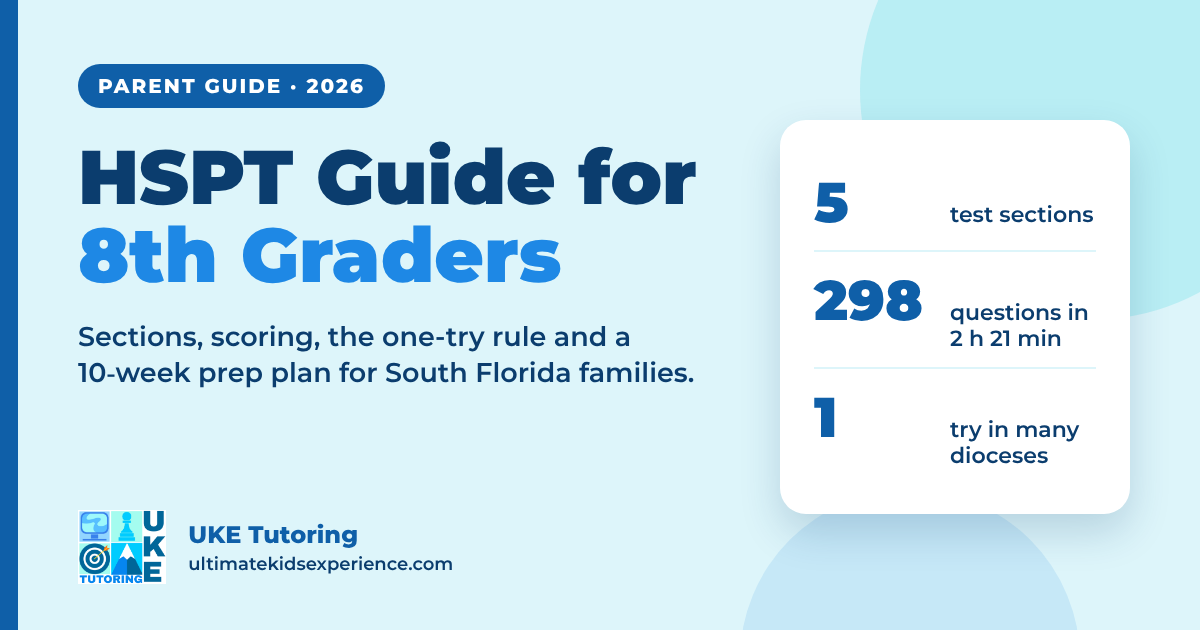
| Format | 298 multiple-choice questions in 5 sections, 2 h 21 min of testing (about 3 hours with breaks) |
| Scores | 200 to 800 per section (500 is average), plus national percentiles |
| Calculator | Not allowed, unless approved as an accommodation |
| Wrong answers | No penalty |
| Retakes | In many dioceses, none: one attempt in 8th grade |
| Publisher | Scholastic Testing Service (STS) |
Why the HSPT matters more than many parents expect
Most families see the HSPT as the admission test, and it is. But many schools also use the same results to award merit scholarships and to decide which English and math level your child starts in, honors or regular. One morning in 8th grade can shape both the tuition bill and the 9th-grade schedule.
The stakes are higher because, in many dioceses, the test cannot be retaken. A make-up date is not a second chance, and a score earned in 7th grade can count as final. Unlike the SAT, where students can test again and improve, the HSPT rewards being ready the first time. Rules vary, so confirm with your school, but plan as if there is one try.
What’s on the test, and why speed is the real challenge
The questions themselves are at an 8th-grade level. What surprises students is the pace:
| Section | Questions | Time | Time per question |
|---|---|---|---|
| Verbal Skills | 60 | 16 min | about 16 seconds |
| Quantitative Skills | 52 | 30 min | about 35 seconds |
| Reading | 62 | 25 min | about 24 seconds |
| Mathematics | 64 | 45 min | about 42 seconds |
| Language | 60 | 25 min | about 25 seconds |
Here is what each section really asks of your child:
- Verbal Skills (synonyms, antonyms, analogies, word logic): at 16 seconds a question, there is no time to puzzle over a word. Vocabulary has to be instant.
- Quantitative Skills (number series, comparisons, number puzzles): this is pattern-spotting more than school math, and most students have never seen these formats. That makes it one of the fastest sections to improve with practice.
- Reading (short passages, vocabulary in context): strong readers do well here, but only if they don’t spend too long on any one passage.
- Mathematics (arithmetic, fractions, percentages, basic algebra, geometry, word problems): the content is familiar. Doing it all by hand, quickly, is the hard part for students used to calculators.
- Language (grammar, punctuation, capitalization, spelling, sentence structure): many errors here come from rushing, not from not knowing the rule.
Making sense of the score report
Each section gets a standard score from 200 to 800, where 500 is the average, and a national percentile from 1 to 99. The percentile is the easiest number to read: a 75th percentile means your child scored higher than about 75% of students who took the test.
The report also groups results into Cognitive Skills (Verbal and Quantitative, closer to reasoning ability) and Basic Skills (Reading, Mathematics and Language, closer to what is taught in class), plus an overall composite. A gap between the two can tell you a lot: strong reasoning with weaker basic skills often points to gaps that targeted review can close.
As for what counts as a “good” score, there is no universal cutoff. Each school sets its own expectations, and scholarship programs usually look for results well above average. The admissions office is the best source for your target school.
Timeline for South Florida families
There is no single national date. Each Catholic high school, or its diocese, chooses its own testing day, most often between November and January. Early in 8th grade, check each school’s admissions page and write down:
- the test date and any make-up date,
- the registration deadline and fee,
- the deadline to request accommodations, which is often weeks before the test,
- how many schools can receive your child’s scores.
A 10-week prep plan
About ten weeks is the sweet spot: enough time to learn the unusual question types and build speed, without overloading a student who still has homework and activities.
| Weeks | Focus |
|---|---|
| 1 to 2 | A full diagnostic test to find the weakest sections |
| 3 to 5 | Learn each question type, especially analogies and number series; rebuild mental math |
| 6 to 8 | Timed practice, section by section, and learning when to skip and come back |
| 9 to 10 | Full-length timed tests under real conditions, with a careful review of every mistake |
Less time than that? Preparation still pays off; it just needs sharper focus. Start with one diagnostic test, then put most of the effort into the two weakest sections and into pacing. Verbal and Quantitative usually bring the quickest gains because their question types follow predictable patterns.
Five habits that make the biggest difference
- Never leave a blank. Since wrong answers cost nothing, a guess always beats an empty bubble.
- Practice with a timer from day one. Knowing the material is not enough if it takes too long.
- Do a few minutes of mental math every day. Fractions and percentages should feel automatic.
- Read every day. It builds vocabulary for Verbal and stamina for Reading at the same time.
- Study the mistakes, not the score. Understanding why an answer was wrong is where most progress comes from.
The night before and test morning
- A good night of sleep and a real breakfast matter more than last-minute studying.
- Pack what the school asks for, usually the registration confirmation and No. 2 pencils.
- Arrive early: late students may not be admitted.
- Remind your child to keep moving: skip a hard question, mark it, and come back if time allows.
How UKE Tutoring helps with HSPT prep
Our 1:1 online HSPT prep package follows the plan above: 10 private sessions of 1.5 hours (15 hours), one per week over 10 weeks, starting with a diagnostic test, then targeted work on your child’s weakest sections, timing strategies, and timed practice tests with personal feedback after each one. If the test date is closer, we can schedule 2 sessions per week, so the full program fits in about 5 weeks.
Sessions are online, scheduled around your family’s calendar, with tutors who attend top US universities. We work with families across South Florida (Broward, Miami-Dade and Palm Beach counties) and beyond, since every session is online.
Not sure if there is enough time? Text or WhatsApp Fred at (754) 707-1070 with your child’s test date, and we’ll give you an honest answer and a plan.
Other questions parents ask
Is the HSPT hard?
The material isn’t the hard part: it’s 8th-grade level. The pace is. Most students find the timing much harder than the questions, which is why timed practice matters so much.
Can public school students take the HSPT?
Yes. The HSPT is open to 8th graders from public, private and Catholic middle schools who apply to a Catholic high school. Students usually register and take the test at the high school, so the process is the same for everyone.
HSPT, ISEE or SSAT: which one does my child need?
All three are 9th-grade entrance exams. Catholic high schools typically use the HSPT, while many independent private schools use the ISEE (Independent School Entrance Exam) or the SSAT (Secondary School Admission Test). If your child applies to both kinds of schools, they may need two different tests, so check early.
Will there be a religion or science section?
Some schools add one short optional section, usually Science or Catholic Religion. Ask each school whether it includes one, since it changes what to review.
What if my child needs testing accommodations?
Testing sites typically offer extended time and other accommodations for students with documented needs, but the paperwork is usually due several weeks before the test. Contact the school as soon as you know your child’s test date.
More free help for South Florida families: see our Family Resource Guide, with official SAT and ACT practice, AP resources, Bright Futures, FAFSA and college planning links.
Sources: HSPT information for parents, Scholastic Testing Service (test publisher) · About the HSPT, Archdiocese of Washington Catholic Schools · High School Placement Test, Archdiocese of Baltimore · High School Placement Test, Diocese of Arlington · Your Guide to the HSPT, Test Innovators (section question counts)
UKE Tutoring is an independent tutoring service and is not affiliated with Scholastic Testing Service or any school or diocese. Test rules and dates can change: always confirm with your school.